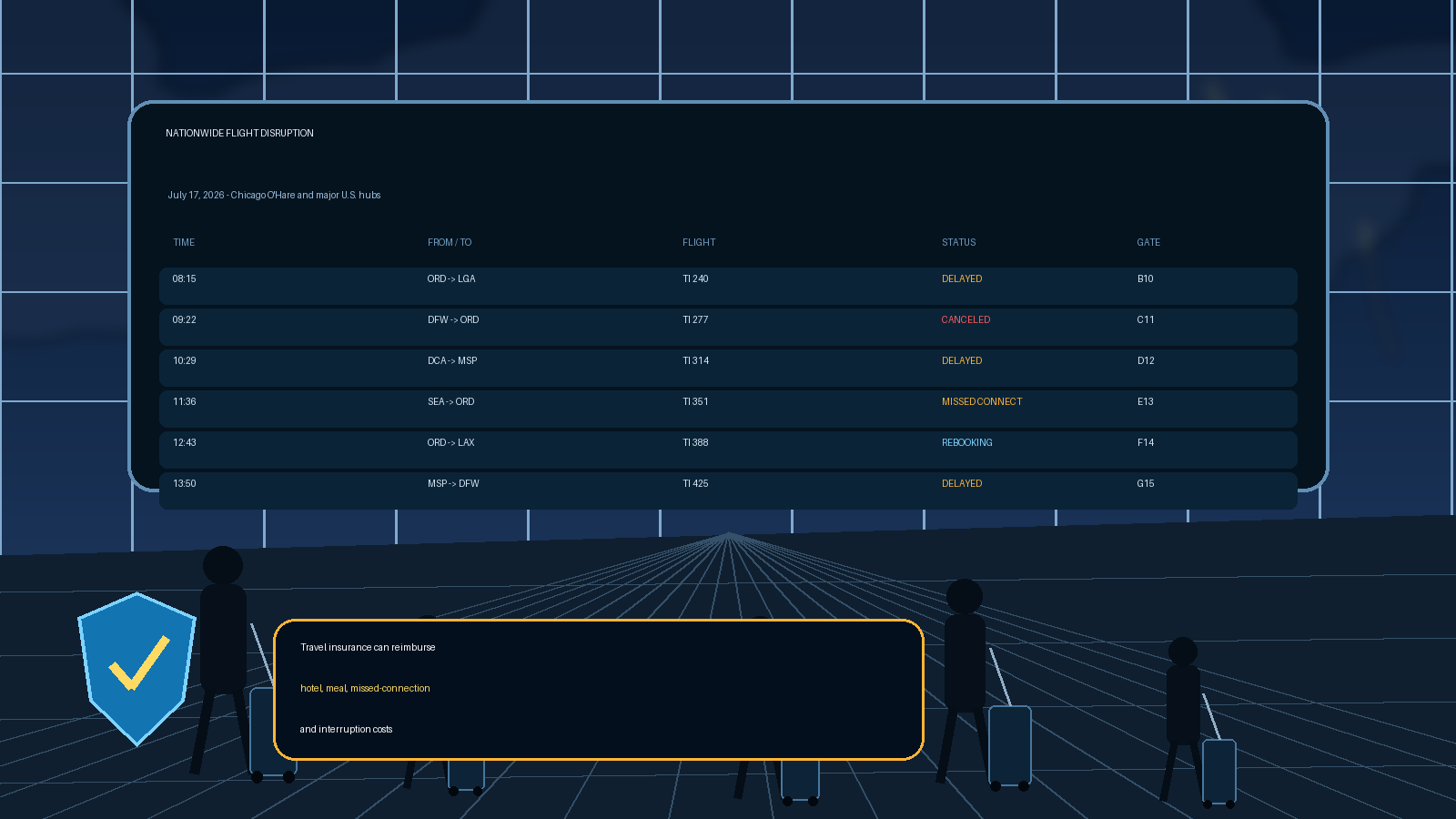
Chicago O’Hare flight disruption: what travelers should do after nationwide delays
A new wave of U.S. airport disruption hit travelers on Friday, July 17, 2026, turning routine summer itineraries into rebooking puzzles, missed connections, and expensive airport overnights.
According to a July 17, 2026 NJ.com report surfaced through Bing News, more than 1,709 flights were delayed and 99 flights were canceled as airports nationwide faced travel disruption. The same report identified Chicago O’Hare International Airport as the airport feeling the biggest impact, with 133 total delays reported. One day earlier, on July 16, 2026, NJ.com reported an even larger nationwide disruption: more than 3,600 delayed flights and 83 cancellations, with airports in Texas, Illinois, Washington, D.C., Washington state, and Minnesota among the most affected.
That matters because this was not a single-destination vacation problem. It was the kind of hub-driven disruption that can break trips across the country: a family connecting through O’Hare, a business traveler routed through Dallas, a cruise passenger trying to reach a port city, or an international traveler whose first domestic leg arrived too late for the overseas flight.
If you are booking summer travel through a major hub, do not wait until the delay board is already glowing orange. Compare travel delay, missed connection, and trip interruption benefits before departure: Compare Plans Here.
What happened on July 17, 2026?
The July 17 report described a nationwide flight disruption affecting multiple U.S. airports, with the headline number reaching more than 1,709 delayed flights and 99 canceled flights. Chicago O’Hare stood out as the most impacted airport in that update, with 133 total delays.
The timing is important. This was reported during the peak summer travel window, when flights are full, crews are stretched, hotel inventory near airports can disappear quickly, and same-day replacement seats can be expensive or unavailable. Even when an airline eventually rebooks a traveler, the traveler may still face costs the airline does not automatically pay.
The pattern also followed a difficult prior day. On July 16, 2026, a separate NJ.com report said more than 3,600 flights were delayed and 83 were canceled as nationwide disruptions created airport chaos. Airports in Texas, Illinois, Washington, D.C., Washington state, and Minnesota were cited among the hardest-hit areas.
For travelers, two consecutive days of disruption can be worse than one bad afternoon. Aircraft, crews, gates, baggage, and passengers may remain out of position into the next operating day. That is how a Friday delay can become a Saturday missed tour, a lost hotel night, or a cruise departure you cannot reach.
Why Chicago O’Hare disruptions ripple so widely
Chicago O’Hare is one of the most important connecting airports in the United States. A traveler does not need to be visiting Chicago to be affected by an O’Hare disruption. If your itinerary routes through ORD, a delay there can affect trips to New York, Los Angeles, London, Tokyo, Cancun, Denver, Miami, or almost anywhere else in the network.
When a major hub slows down, the damage spreads in several ways:
- Inbound aircraft arrive late. Your plane may be delayed before it ever reaches your departure airport.
- Crews fall out of position. A flight can be delayed even if the aircraft is available because the crew is not.
- Connections shrink or disappear. A 50-minute layover becomes impossible when the first flight lands 90 minutes late.
- Bags miss the transfer. You may make the flight while your checked luggage does not.
- Airport hotels fill up. Last-minute rooms near a major hub can become scarce and expensive.
- Prepaid travel plans keep moving. Hotels, tours, cruises, rental cars, and events may not refund you just because your flight was delayed.
That is why a travel insurance policy can be so valuable. Airline rebooking rules and federal refund protections are important, but they are not the same thing as reimbursement for every extra cost caused by the disruption.
Before your next hub-heavy itinerary, Compare Plans Here and look closely at the policy’s travel delay, missed connection, baggage delay, and trip interruption sections.
Does travel insurance cover nationwide flight delays?
Often, yes — but coverage depends on the policy, the cause of the delay, the length of the delay, and when you bought the plan.
A comprehensive travel insurance policy may cover flight delays caused by covered reasons such as severe weather, mechanical issues, common carrier delays, air traffic control disruption, airport operational problems, or other events named in the policy. The key is that the problem must usually be unforeseen when you purchase coverage.
If a traveler bought insurance before the July 17 disruption became known, and their delay meets the policy’s waiting period, several benefits could apply.
1. Travel delay coverage
Travel delay coverage is the benefit most travelers think of first. It can reimburse reasonable extra expenses when a covered delay lasts longer than the policy’s minimum waiting period.
Depending on the policy, that waiting period might be 3, 6, 8, 12, or 24 hours. Reimbursable expenses may include:
- Airport meals and bottled water
- A hotel room if the delay requires an overnight stay
- Transportation between the airport and hotel
- Essential toiletries
- Phone chargers or other necessary incidentals
Limits matter. One plan may reimburse $150 per person per day, while another may reimburse $300 or more. If you are delayed near a high-cost hub like Chicago O’Hare, that difference can matter fast.
2. Missed connection coverage
Missed connection coverage may help if the July 17 disruption caused you to miss an onward flight, cruise departure, guided tour, or other scheduled transportation.
This benefit is especially important for travelers with tight connections through major hubs. For example, if your first flight into O’Hare arrived too late for your transatlantic departure, the airline may rebook the flight segment, but it may not reimburse every lost prepaid hotel night, tour, or ground transfer.
Some policies include missed connection coverage specifically for cruises and tours. Others apply more broadly. Before buying, compare definitions and waiting periods: Compare Plans Here.
3. Trip interruption coverage
Trip interruption coverage can help when a covered disruption forces you to cut a trip short, join it late, or take a different route to continue the trip.
For the July 17 nationwide flight delays, this could matter if a traveler:
- Missed the first night of a prepaid hotel stay
- Had to buy a new flight to catch up with a tour
- Needed alternate transportation after a canceled leg
- Lost non-refundable activities because arrival was pushed back
- Had to return home early after the itinerary became impossible
Trip interruption is not automatic reimbursement for inconvenience. You typically need documentation showing the covered reason, the actual delay or cancellation, and the unused prepaid expenses or additional transportation costs.
4. Baggage delay coverage
Nationwide flight disruptions can separate travelers from their checked bags. If you arrive but your luggage does not, baggage delay coverage may reimburse essential purchases after a waiting period.
That can include clothing, toiletries, medication replacements where allowed, and other necessities. Save receipts and keep airline baggage reports. A delayed bag claim is much stronger when you can show the airline’s written confirmation and the time the bag was delivered.
5. Trip cancellation coverage
Trip cancellation coverage is more limited for a delay that happens on the day of travel, but it can still matter in some scenarios. If a covered flight disruption makes it impossible to take the trip as planned, and the policy lists that situation as a covered reason, travelers may be able to recover prepaid, non-refundable trip costs.
The details are policy-specific. Some plans require a common carrier delay of a certain length before cancellation benefits apply. Others may treat the same facts under trip interruption instead. This is why comparison is so important before you buy.
What airlines may owe versus what travel insurance can reimburse
Travelers often assume that if an airline delay caused the problem, the airline will pay for everything. That is not always true.
An airline may rebook you, refund a canceled flight, or provide meal and hotel vouchers depending on the reason for the disruption and the airline’s policies. But airlines generally do not reimburse every downstream travel loss. A prepaid Airbnb, missed concert ticket, non-refundable safari deposit, cruise no-show penalty, or private transfer may sit outside the airline’s responsibility.
Travel insurance is designed to help with those wider trip costs when the event is covered. In a hub disruption like the July 17 O’Hare delays, the most valuable benefits may be the ones that connect the dots between the flight problem and the rest of the trip.
What affected travelers should do right now
If you were caught in the July 17, 2026 nationwide delays, take these steps before memories fade and receipts disappear:
- Get written proof from the airline. Save cancellation notices, delay texts, emails, app screenshots, and any explanation the airline provides.
- Keep every receipt. Meals, hotels, rideshares, toiletries, replacement clothing, and rebooking costs should be documented.
- Document the timeline. Note scheduled departure, actual departure, scheduled arrival, actual arrival, and missed connection times.
- Ask for airline assistance first. If the airline provides a voucher or refund, your insurer may account for that when processing the claim.
- Contact your insurer quickly. Many policies require prompt notice and may have specific claim forms.
- Do not discard boarding passes or baggage tags. They can support both delay and baggage claims.
If you do not yet have a policy for an upcoming trip, use this event as a reminder to compare coverage while future disruptions are still unknown: Compare Plans Here.
What to look for in a policy before your next flight
For travelers connecting through Chicago O’Hare or any major U.S. hub, prioritize these policy features:
- Short travel delay waiting period: A 3- or 6-hour trigger is more useful than a 12- or 24-hour trigger.
- Strong per-person daily limits: Airport hotels and meals add up quickly.
- Missed connection coverage: Especially important for cruises, tours, international flights, and tight layovers.
- Trip interruption benefits above 100% of trip cost: Some plans reimburse extra transportation in addition to unused trip costs.
- Baggage delay coverage: Helpful when bags miss a connection during systemwide disruption.
- Clear common carrier language: Look for how the policy defines airline delays, cancellations, and covered transportation providers.
- 24/7 assistance: Rebooking and emergency support can matter when you are stranded after business hours.
The cheapest policy is not always the best policy for flight disruption. A plan with weak delay benefits may save a few dollars upfront but leave you exposed to hundreds in airport hotel and meal costs. Compare the details side by side before you buy: Compare Plans Here.
The bottom line
The July 17, 2026 nationwide flight disruption — with more than 1,709 delayed flights, 99 cancellations, and Chicago O’Hare among the hardest-hit airports — is a practical reminder that travel risk is not limited to hurricanes, typhoons, or international crises. A bad day at a major hub can derail an entire vacation.
Travel insurance cannot make a delayed plane leave on time. But the right policy can help pay for the costs that follow: hotels, meals, taxis, missed connections, lost prepaid bookings, delayed baggage, and alternate transportation.
If your next trip includes a connection through Chicago O’Hare, Dallas-Fort Worth, Minneapolis-St. Paul, Seattle, Washington, D.C., or any other major hub, build protection into the itinerary before the next disruption becomes a known event. Start here: Compare Plans Here.