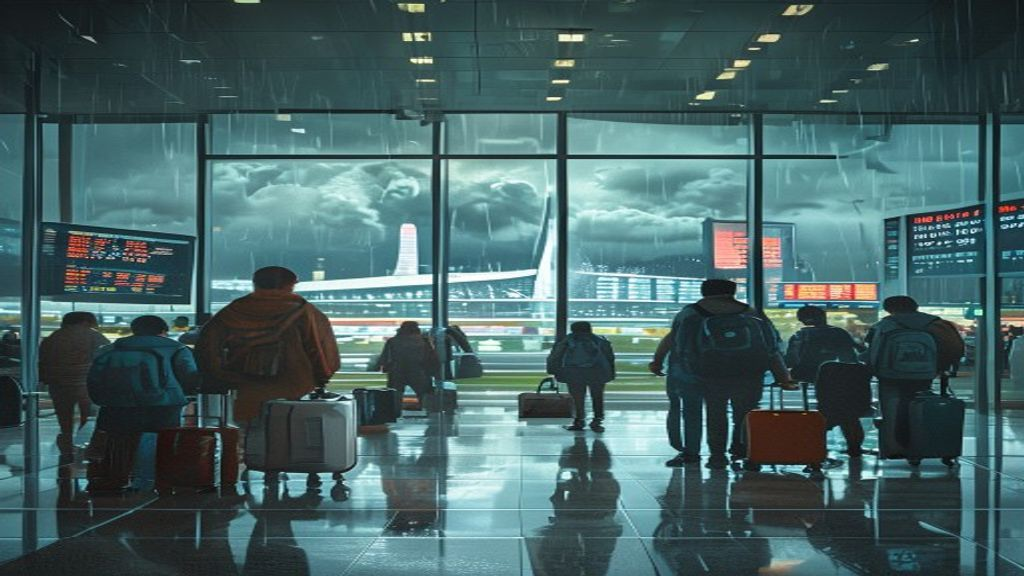
Typhoon Noul flight cancellations: what travelers need to know after Hong Kong and southern China disruption
A new wave of severe-weather travel disruption hit East Asia over the weekend as Typhoon Noul made landfall in southern China on Sunday, July 26, 2026, forcing evacuations, suspending train service, and canceling hundreds of flights across Hong Kong, Guangdong, Shenzhen, and nearby regional routes.
According to reports published on July 26, 2026, Noul struck the coast of Huidong County in Guangdong at about 3:50 a.m. local time after sweeping across Hong Kong and the southern China coast with heavy rain and gale-force winds. The Guardian, citing state media and local authorities, reported that more than 715,000 people were relocated for safety in Guangdong, train services in the province were canceled for Sunday, and about 350 flights were canceled at Hong Kong International Airport. Hong Kong officials said flights were expected to begin resuming gradually on Sunday afternoon, but widespread disruption had already rippled through regional itineraries.
Airlines serving the region also announced route-specific cancellations. Malaysia Airlines said it canceled flights scheduled for July 25 and July 26 between Kuala Lumpur, Shenzhen, and Hong Kong, including MH522, MH523, MH078, and MH079, because of deteriorating conditions linked to Typhoon Noul. AirAsia services on Kuala Lumpur-Shenzhen, Kuala Lumpur-Hong Kong, and Kuala Lumpur-Guangzhou routes were also reported canceled or delayed.
For travelers, this is exactly the kind of real-world event where the cheapest policy is rarely the best policy. Typhoon disruption can mean an overnight airport stay, a missed international connection, a lost prepaid hotel night, or a cruise or tour departure you cannot reach on time. Before booking peak-season travel through typhoon-prone airports, compare plans with strong delay, missed connection, and trip interruption benefits: Compare Plans Here.
What happened during Typhoon Noul?
Typhoon Noul was reported as the strongest typhoon to make landfall in China so far in 2026. The storm brought powerful winds and heavy rain to southern China, including Hong Kong and Guangdong, then moved inland while weakening.
The key reported travel facts were:
- Event: Typhoon Noul severe-weather disruption
- Main date: Sunday, July 26, 2026
- Landfall: Around 3:50 a.m. on the coast of Huidong County, Guangdong
- Wind conditions: Hong Kong’s Observatory reported maximum sustained winds near the storm’s center of about 110 km/h / 68 mph as Noul moved inland and weakened
- Evacuations: More than 715,000 people relocated for safety in Guangdong, according to state media cited by The Guardian
- Hong Kong airport impact: About 350 flights canceled on Sunday, with operations expected to resume gradually later in the day
- Ground transport impact: Train services in Guangdong were canceled for Sunday, according to China News Service
- Airline route impact: Malaysia Airlines canceled Kuala Lumpur-Shenzhen and Kuala Lumpur-Hong Kong services scheduled for July 25 and July 26; AirAsia flights to Shenzhen, Hong Kong, and Guangzhou were also reported canceled or delayed
The timing created a difficult problem for travelers. Weekend departures are often packed with families, cruise passengers, business travelers, international students, and long-haul connections. When a typhoon shuts down air and rail links at the same time, rebooking is not as simple as waiting for the next flight.
Why a typhoon can disrupt travel even after the storm weakens
A common mistake is assuming travel normalizes the moment a typhoon moves inland. In reality, airline networks can stay tangled for days.
Typhoon Noul affected travel in several overlapping ways:
- Aircraft were out of position. A plane scheduled to operate a Hong Kong departure may have been stuck in another city because its earlier leg was canceled.
- Crew schedules were disrupted. Flight crews can time out even after weather improves, forcing airlines to cancel flights that technically could operate.
- Airport capacity restarted gradually. Hong Kong’s airport authority said operations would resume gradually, which means flights do not all restart at once.
- Rail alternatives were limited. Guangdong train service cancellations reduced backup options for travelers who might otherwise switch from air to rail.
- Hotel demand surged. When hundreds of flights are canceled, airport hotels and city-center rooms can fill quickly.
- Baggage can lag behind passengers. Rerouted travelers and checked bags may not move on the same replacement itinerary.
That is why travel insurance is not just about the canceled flight. It is about the extra costs that pile up after the cancellation: hotel nights, meals, taxis, essentials, missed tours, and non-refundable reservations.
If you are planning travel through Hong Kong, Shenzhen, Guangzhou, Taipei, Manila, Singapore, Kuala Lumpur, or other storm-exposed hubs during typhoon season, Compare Plans Here before the next named storm becomes a known event.
Does travel insurance cover Typhoon Noul flight cancellations?
Often, yes — but only if the policy was purchased before Typhoon Noul became a known or foreseeable event, the plan includes the relevant covered reasons, and the traveler meets the policy’s timing and documentation requirements.
Most comprehensive travel insurance policies include some combination of:
- Travel delay coverage
- Trip interruption coverage
- Missed connection coverage
- Trip cancellation coverage
- Baggage delay coverage
- Emergency assistance services
Weather-related disruption is commonly covered, but policy wording matters. Some plans specifically name severe weather, natural disasters, airport closures, common carrier delays, or mandatory evacuation. Others use narrower definitions or require a minimum delay length before benefits begin.
For Typhoon Noul, the most relevant benefits are likely travel delay, missed connection, trip interruption, and baggage delay.
1. Travel delay coverage: hotels, meals, and airport expenses
Travel delay coverage can reimburse reasonable additional expenses when a covered delay lasts longer than the policy’s waiting period. Depending on the plan, benefits may begin after 3, 6, 8, 12, or 24 hours.
For travelers affected by the July 26 Hong Kong and Guangdong disruption, travel delay coverage may help pay for:
- Airport meals during a long wait
- Hotel rooms if the next available flight is the following day
- Transportation between the airport and hotel
- Basic toiletries and necessities
- Phone chargers or other essential incidentals
- Extra local transportation caused by airline rebooking
This benefit can be especially important in Hong Kong, where last-minute hotel rooms and airport transfers can become expensive during a major storm. If a family of four is stranded overnight after a canceled flight, even one hotel night plus meals and taxis can cost hundreds of dollars.
Before buying, compare the daily and total limits. A plan offering $150 per person per day may be enough for some trips, while a long-haul international itinerary may justify a higher benefit: Compare Plans Here.
2. Missed connection coverage: when one canceled flight breaks the whole itinerary
Missed connection coverage can help if a covered delay causes you to miss a cruise, tour, onward flight, train, or other scheduled transportation.
This matters because Hong Kong and southern China are not isolated endpoints. They are major gateways for travelers connecting across Asia, Europe, Australia, and North America. A canceled Kuala Lumpur-Hong Kong flight, delayed Shenzhen connection, or suspended Guangdong train can cause travelers to miss:
- An onward international flight
- A cruise departure
- A prepaid tour start date
- A domestic China rail connection
- A separate-ticket low-cost carrier flight
- A non-refundable hotel check-in night
Airlines may rebook passengers on the same ticket, but they generally do not cover every downstream loss — especially if the missed service was booked separately. Travel insurance can help bridge that gap when the missed connection is caused by a covered common carrier delay or severe-weather event.
Read the missed connection section carefully. Some policies are cruise-focused, while others are broader and can apply to flights and tours. If your itinerary has separate tickets, tight layovers, or a cruise departure, this is one of the most important benefits to compare.
3. Trip interruption coverage: joining the trip late or rerouting around the storm
Trip interruption coverage can reimburse certain unused prepaid trip costs and additional transportation expenses when a covered event disrupts a trip after departure.
For Typhoon Noul, trip interruption coverage might apply if a traveler:
- Missed the first night of a prepaid hotel stay in Hong Kong, Shenzhen, or Guangzhou
- Had to buy a new flight to catch up with a tour group
- Needed to reroute through another airport after Hong Kong service was canceled
- Lost prepaid event tickets or excursions because arrival was delayed
- Had to return home because the trip could no longer continue as planned
The key phrase is covered event. A typhoon-related airport disruption may qualify under severe weather, natural disaster, common carrier delay, or airport closure language. But the exact wording differs by plan.
Trip interruption claims typically require strong documentation. Save airline cancellation notices, app alerts, boarding passes, receipts, hotel invoices, proof of prepaid costs, and any written statement from the airline explaining that the delay or cancellation was caused by Typhoon Noul or severe weather.
4. Trip cancellation coverage: when the storm makes the trip impossible before departure
Trip cancellation coverage applies before you leave home. If your flight is canceled because of a covered severe-weather event and the policy’s waiting period or cancellation conditions are met, you may be able to recover prepaid, non-refundable trip costs.
Examples could include:
- A Hong Kong hotel booking that will not refund the first night
- A tour package beginning before the next available flight arrives
- Non-refundable internal transportation in China or Southeast Asia
- Event tickets tied to a specific date
- Prepaid excursions that cannot be rescheduled
Not every short delay qualifies for trip cancellation. Some plans require a common carrier delay of a certain length, such as 12, 24, or 48 hours, before cancellation benefits apply. Others require a formal airport closure or a mandatory evacuation affecting the destination.
This is why buying coverage early matters. Once a storm is named, tracked, and widely forecast, insurers may treat it as a known event for new purchases.
5. Baggage delay coverage: essentials when bags and passengers separate
Large-scale rebooking can separate checked luggage from travelers. Baggage delay coverage may reimburse essential purchases if your luggage is delayed beyond the policy’s waiting period.
Covered purchases may include:
- Toiletries
- Basic clothing
- Medication replacement support where allowed by the policy
- Chargers and small travel necessities
- Weather-appropriate items if your bag is stuck elsewhere
Keep itemized receipts and file a baggage report with the airline before leaving the airport. Credit card statements alone may not be enough for a claim.
What airlines may offer versus what travel insurance can cover
Airlines and travel insurance solve different problems.
For the Typhoon Noul cancellations, Malaysia Airlines said affected passengers could request refunds or rebook journeys on the same route at no additional cost within 30 days of the original travel date. That is helpful, but it does not necessarily pay for every related expense.
An airline may offer:
- A refund for a canceled flight
- Rebooking on the same airline or route
- Schedule-change notifications
- Limited vouchers depending on the airline, jurisdiction, and cause of disruption
Travel insurance may help with broader trip costs, including:
- Hotels during an overnight delay
- Meals and necessary local transportation
- Missed prepaid lodging or tours
- Extra airfare to catch up with a trip
- Baggage-delay essentials
- Trip interruption costs after departure
The difference is crucial. If the airline refunds a $300 flight but you lose a $1,200 prepaid tour and spend $450 on a hotel, meals, and taxis, the flight refund alone does not make you whole.
What affected travelers should do now
If your trip was disrupted by Typhoon Noul, take these steps immediately:
- Save every airline notice. Keep emails, app screenshots, text alerts, and website status pages showing the cancellation or delay.
- Ask for the reason in writing. The claim is stronger when the airline identifies severe weather, typhoon conditions, airport disruption, or operational restrictions.
- Keep receipts. Save itemized receipts for hotels, meals, taxis, toiletries, and replacement essentials.
- Document unused prepaid costs. Gather invoices and cancellation policies for hotels, tours, cruises, events, and transfers.
- Do not assume all expenses are covered. Check the policy’s waiting period, per-day limits, total limits, exclusions, and covered reasons.
- Contact the insurer quickly. Many plans require prompt notice and may offer emergency assistance for rebooking or medical needs.
- Avoid duplicate reimbursement. If the airline refunds a specific expense, insurance generally will not reimburse the same cost again.
How to choose travel insurance for typhoon-season trips
Typhoon season can affect major Asian travel hubs with little practical warning for travelers already en route. A strong policy should include more than basic cancellation coverage.
Look for:
- Travel delay benefits with realistic daily limits
- Missed connection coverage that applies to flights, cruises, and tours
- Trip interruption benefits for extra transportation and unused prepaid costs
- Weather and natural disaster language that fits your destination risk
- Baggage delay coverage with reasonable waiting periods
- 24/7 emergency assistance
- Coverage for separate-ticket itineraries if your trip uses multiple bookings
- Optional Cancel For Any Reason coverage if you want broader flexibility before departure
The best time to compare is before a storm enters the forecast. Once a typhoon is named and threatening your route, new policies may not cover that specific storm. Compare coverage now, before the next disruption is known: Compare Plans Here.
Bottom line: Typhoon Noul shows why travel insurance must cover the ripple effects
Typhoon Noul was not just a weather headline. It was a real travel disruption that canceled hundreds of flights, forced mass evacuations, suspended regional train service, and left travelers scrambling across Hong Kong, Guangdong, Shenzhen, and connecting routes.
Airlines can rebook flights, but they do not automatically reimburse every hotel night, missed tour, transfer, meal, or prepaid cost that follows. Comprehensive travel insurance can help protect travelers from those ripple effects when the event is covered and the policy was purchased in time.
If your next trip depends on a major hub during storm season, do not wait until the flight board turns red. Compare Plans Here and choose a policy with strong travel delay, missed connection, trip interruption, and baggage delay protection before severe weather threatens your itinerary.